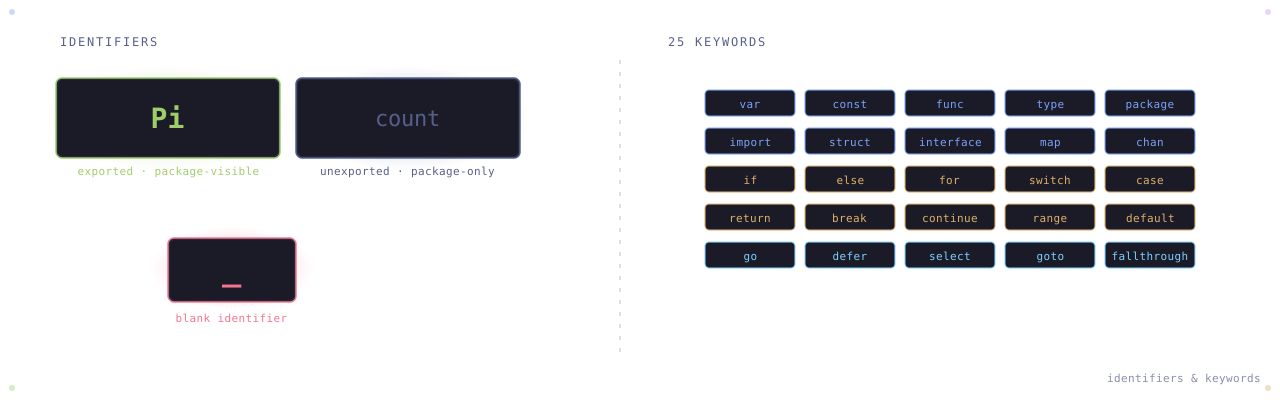
What an identifier is
An identifier is the name you give to something in your program — a variable, a constant, a type, a function, a package. Every name you write in Go is an identifier.
The language spec defines exactly what characters are allowed:
- An identifier is formed by one or more Unicode letters and Unicode digits
- The first character must be a letter — digits are not allowed at the start
- The underscore
_counts as a letter
age         // valid
_           // valid — the blank identifier
_count      // valid — underscore is a letter
user123     // valid — digit after the first character
café        // valid — Unicode letters are allowed
123abc      // invalid — starts with a digit
my-variable // invalid — hyphens are not letters
Go is case-sensitive. count, Count, and COUNT are three distinct identifiers.
Exported vs unexported
The case of the first letter carries a specific meaning in Go. An identifier that starts with an uppercase letter is exported — it is visible and accessible from other packages. One that starts with a lowercase letter is unexported — it is private to the package it is defined in.
package math

var internalState = 0  // unexported — only visible inside this package
var Pi = 3.14159       // exported — accessible as math.Pi from anywhere
This is not a convention — it is enforced by the compiler. There are no public or private keywords in Go. Capitalization is the entire access control mechanism.
The blank identifier
The underscore on its own — _ — is a special identifier called the blank identifier. It acts as a write-only discard slot: you can assign to it, but you can never read from it.
Its most common use is discarding values you do not need:
value, _ := strconv.Atoi("42") // discard the error
Go requires that every declared variable is used. The blank identifier lets you satisfy that requirement when a function returns multiple values and you only care about some of them.
Predeclared identifiers
Go comes with a set of identifiers that are always available in every program without any import. They are defined in the universe block — the outermost scope that wraps all Go code.
Unlike keywords, predeclared identifiers are not reserved. You can technically shadow them by declaring your own identifier with the same name. You almost certainly should not — doing so removes access to the original and creates confusing code.
Types
any        bool       byte       comparable
complex64  complex128 error      float32
float64    int        int8       int16
int32      int64      rune       string
uint       uint8      uint16     uint32
uint64     uintptr
You have already seen most of these in the basic types article. any is an alias for interface{} — the type that accepts any value. error is an interface type used throughout Go for error handling. comparable is a constraint used in generics.
Constants
Three predeclared constants exist:
trueandfalse— the only values of typebooliota— the compile-time counter used insideconstblocks
The zero value: nil
nil is the zero value for pointers, slices, maps, channels, functions, and interfaces. It is not a keyword — it is a predeclared identifier with no type of its own. Its type is determined by context.
var p *int       // p is nil
var s []string   // s is nil
var m map[string]int // m is nil
Built-in functions
Go provides a set of built-in functions that are always in scope:
| Function | Purpose |
|---|---|
len | Length of a string, slice, map, array, or channel |
cap | Capacity of a slice or channel |
make | Allocate and initialize slices, maps, and channels |
new | Allocate zeroed memory for a type, return a pointer |
append | Append elements to a slice |
copy | Copy elements between slices |
delete | Remove a key from a map |
close | Close a channel |
complex | Construct a complex number from real and imaginary parts |
real | Extract the real part of a complex number |
imag | Extract the imaginary part of a complex number |
panic | Stop normal execution and begin unwinding the stack |
recover | Regain control after a panic |
print | Write to stderr (low-level, for debugging) |
println | Write to stderr with a newline (low-level, for debugging) |
print and println are not fmt.Print
The built-in print and println write to standard error and are intended for low-level debugging during bootstrap — before the runtime is fully initialized. For any real output, use the fmt package: fmt.Print, fmt.Println, fmt.Printf.
Keywords
Keywords are words that the Go language itself has claimed. They have fixed meanings built into the compiler and cannot be used as identifiers — you cannot name a variable func or a type for.
Go has exactly 25 keywords. This small number is deliberate — fewer keywords means a smaller language that is easier to learn and easier to read.
Declaration and types
These keywords introduce new entities into the program:
| Keyword | Purpose |
|---|---|
var | Declare a variable |
const | Declare a constant |
type | Declare a new type or type alias |
func | Declare a function or method |
struct | Define a composite type with named fields |
interface | Define a set of method signatures |
map | Declare a map type |
chan | Declare a channel type |
package | Declare the package a file belongs to |
import | Import packages |
Control flow
These keywords control the order of execution:
| Keyword | Purpose |
|---|---|
if / else | Conditional branching |
for | The only loop construct in Go |
range | Iterate over a slice, map, string, or channel |
switch / case / default | Multi-branch conditional |
break | Exit a loop or switch |
continue | Skip to the next loop iteration |
return | Exit a function, optionally returning values |
goto | Jump to a labeled statement |
fallthrough | Continue into the next case in a switch |
Concurrency and deferred execution
| Keyword | Purpose |
|---|---|
go | Launch a goroutine |
select | Wait on multiple channel operations |
defer | Schedule a function call to run when the surrounding function returns |
Go has no while
Go does not have a while keyword. The for loop covers all loop patterns: for {} is an infinite loop, for condition {} is a while loop, and for i := 0; i < n; i++ {} is a classic counted loop.